The high price of order
Order comes at a high price because of the nature of trust. The benefits of keeping a contract are shared and long-term; the benefits of breaking it fall to one party, and they are immediate. Withholding the goods once the payment is in hand, raising the price once the work is half done, putting off repayment again and again once a loan falls due: each of these brings an immediate gain.
If a contract is upheld only by the conscience of the two parties, whoever breaks it first always comes out ahead, and whoever keeps it is taken advantage of over and over. People can then cooperate only on a small scale, within small circles. Cooperation that spans distance, the boundaries of trust and time becomes possible only once some force stands behind the contract and makes those who break it pay, so that the expected cost outweighs the immediate gain.
When you deal with someone only once, breaking the agreement is always the most profitable move in the moment; when the two sides will meet again and again, today’s breach brings retaliation tomorrow, and keeping one’s word becomes the long-term gain.
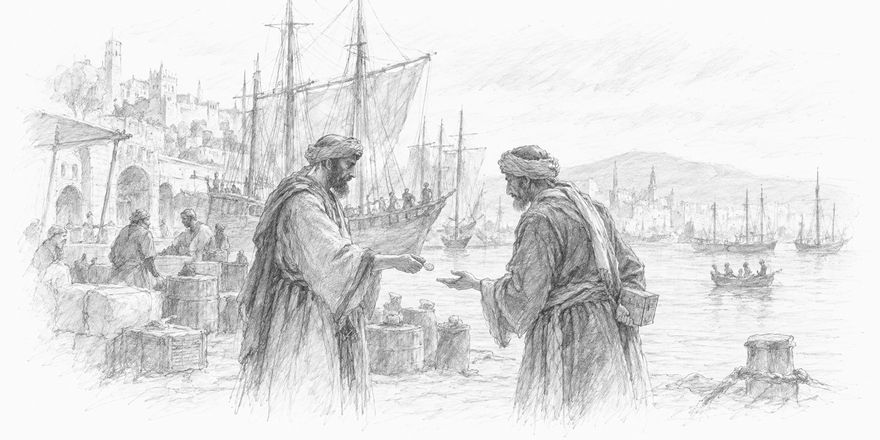
Merchants grasped this early. In the eleventh century, the Jewish Maghribi traders who worked both shores of the Mediterranean entrusted their goods to agents far away, on round trips that often took months. In their letters they kept one another informed about how each agent behaved, and whoever cheated one member was cut off by the whole group, so that a one-time deal was drawn out into a game repeated forever. Many of these letters survive in the storeroom of a synagogue in Cairo and can still be read today. The arrangement worked, yet its reach stopped at the edge of the group: it ran only among people who knew one another and shared news.
Genoa, in the same era, took another road: merchants wrote every partnership and loan into a contract, had a notary register it, and took their disputes to the city’s courts. The register left by the notary Giovanni Scriba in the mid-twelfth century is the oldest notarial record that survives today. With contracts, registration and courts, a partner could be any stranger at all, and the frontier of trade moved further out.
Human societies evolved a rudimentary mechanism of guarantee for this purpose: organized violence on a large scale, which is to say the machinery of the state. Political forms have changed many times over, yet what the state does has always been the same thing. It is the guarantor of last resort for every contract, charged with enforcing a commonly accepted set of rules, and the force that can enforce those rules is violence, which makes the cost of breaking them highly credible.
These expenses are the cost of trust, and so the price of order. The power to define that price is right, in the legal sense of the word; and the machinery of the state stands for right in its most complete form: state sovereignty.
In 1651, with the smoke of the English Civil War barely cleared, Hobbes published Leviathan.
He imagined a “state of nature” in which public power is absent: every man is enemy to every man, a harvest can be seized at any moment, and so farming and trade are abandoned together, and the life of man is “solitary, poor, nasty, brutish, and short”. A contract made in such conditions is only words on paper; for it to carry weight, a sword must stand behind it. In his words, “covenants, without the sword, are but words”. People therefore hand the power of coercion to a common sovereign, in exchange for having their contracts enforced.
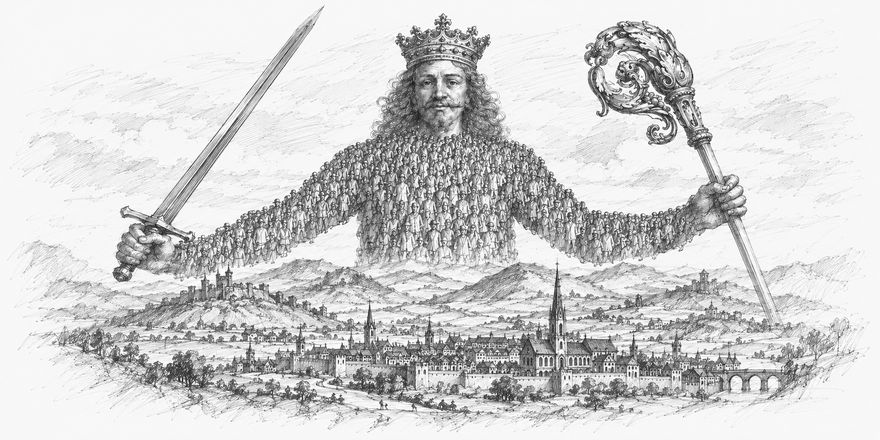
The frontispiece of the book shows a giant whose body is made of thousands of tiny people, holding a sword in one hand and a bishop’s crozier in the other, looming over towns and fields; the title comes from Leviathan, the sea monster of the Book of Job. A seal holds because a sword stands behind it, and the hand that grips the sword is formed from the strength everyone has handed over.
The state advances this cost on everyone’s behalf and recovers it through taxes. It ties record-keeping, adjudication, exchange, property and certification together and supplies them as one package, an arrangement that can be called bundled sovereignty.
What is bundled can only be taken whole: no one can buy one part of it alone, and no one can refuse one part of it alone; the price, and whether the service is good or bad, are decided by the provider alone. The only choice left to people is to accept.
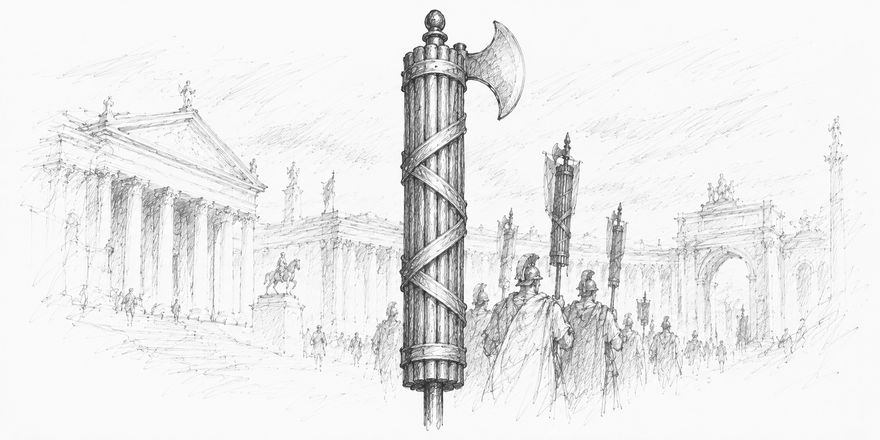
When a Roman consul went out, twelve attendants walked ahead of him, each carrying a fasces on his shoulder: a bundle of rods bound tight with red leather straps, with an axe set in the middle. The rods were for flogging, the axe for beheading; punishment and the power of life and death were bound together and held by one man.
The emblem originated with the Etruscan civilization and, once it reached Rome, became the symbol of a magistrate’s power and jurisdiction; it can fairly be called the very emblem of the Roman consul’s power. In 1898 a small iron fasces was unearthed from a seventh-century BC tomb at the Etruscan city of Vetulonia, and the axe bound into it was a double-headed one. The double axe first joined to the symbol came from Crete and is one of the oldest symbols of ancient Greek civilization; the Romans called it the bipennis.
The Romans themselves knew well what that axe meant. Inside the sacred boundary of the city, the attendants took the axes out of the fasces, a sign that a citizen’s life kept the right of appeal to the people; only a dictator’s fasces carried the axe inside the city. In the modern world the fasces lives on as a representation of authority, collective power, law and governance, appearing on the emblems of some states and in the decoration of parliaments and courts; twentieth-century Italian Fascism also took its name from it.
It draws the state with perfect clarity: a bundle of functions tied together, looking stronger the tighter it is bound, and whoever wants a single rod has to take the whole bundle, axe included.
If the price the state charges for order rises without limit while its service grows too poor for people to survive, then only two choices remain before them, both extremely costly: to flee the reach of the state’s machinery, or to overthrow it and build new machinery in its place.
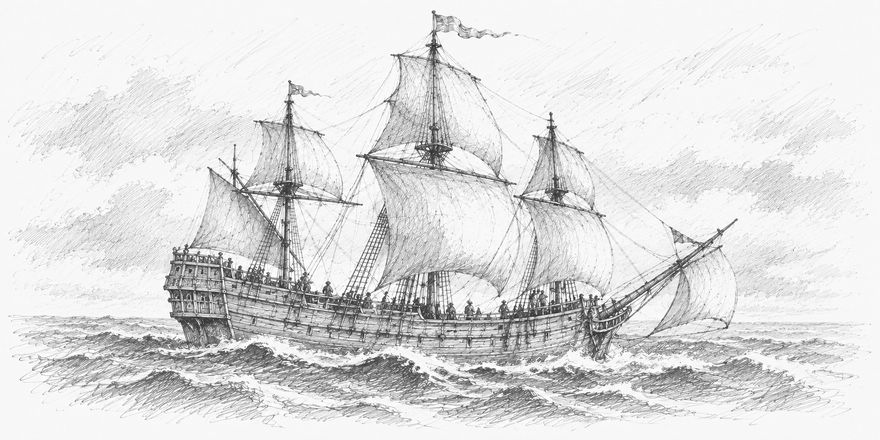
In the autumn of 1620, a hundred and two passengers crowded aboard a cargo ship called the Mayflower to cross the Atlantic. Many of them were Separatist Puritans persecuted in England; they had first fled to the Netherlands, and set out from there for a land far beyond the reach of the English king’s law.
The ship made land at Cape Cod, north of its intended destination, in a place outside the jurisdiction of any existing government. Before going ashore, forty-one men on board signed a brief compact, agreeing to combine into a “civil body politic” and to make and obey just and equal laws for the general good.
This is flight in its typical form: leaving the reach of the old machinery of the state, first setting down a contract for oneself on open ground, and then using it to replace the guarantor left behind. Its cost is just as plain: selling off one’s property and crossing the ocean, and by the end of the first winter nearly half the passengers were dead.
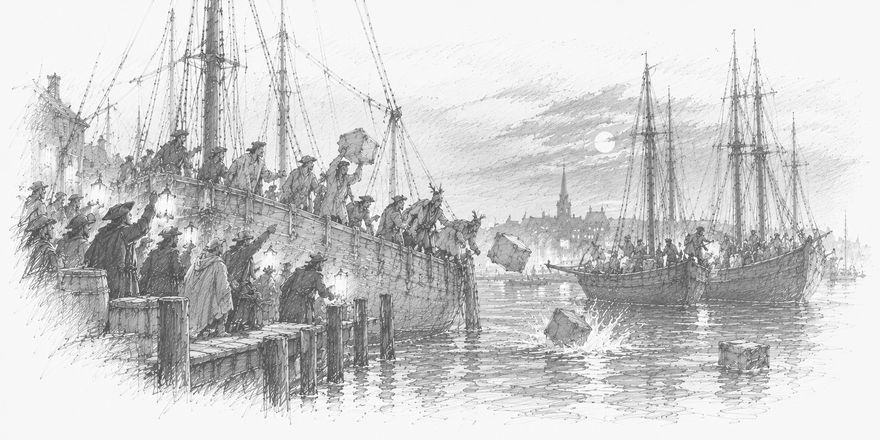
A century and a half later, the people of this land faced the other choice. The British Parliament levied tax after tax on the North American colonies, and every seat in that Parliament was elected by voters in Great Britain; the Tea Act of 1773 then let the East India Company’s tea bypass the colonial merchants and be dumped straight onto the market. On the night of 16 December that year, a group of colonists boarded three ships in Boston Harbor and poured 342 chests of tea into the sea, most of it Bohea from the Wuyi hills of China.
London’s answer was to close the port of Boston and tighten its rule over Massachusetts; the colonies’ delegates then gathered in Philadelphia in 1774 for the First Continental Congress, coordinated a boycott, and soon raised an army. On 4 July 1776 the Second Continental Congress adopted the Declaration of Independence, which set down the reason for this overthrow: governments derive their just powers from the consent of the governed, and whenever any form of government becomes destructive of these ends, it is the right of the people to alter or to abolish it, and to institute new government.
One declaration proclaimed the old guarantor void; what followed was eight years of the War of Independence, and a new machinery of state.