When the state no longer does its job
A guarantor’s worth lies in its fairness, and how long a state endures depends on it as well. When rules are made with care and enforced fairly, people trust that agreements will be kept, and so they are willing to work with strangers, lend money, ship goods to distant places and schedule work years ahead; prosperity follows from this.
The rulers held in awe were mostly those who did this well, and making and enforcing law has accordingly been the theme of politics for thousands of years. The opposite is just as common: verdicts can be bought, rules bend to power, people draw back the hands they had held out for fear of betrayal, trade declines, and unrest follows close behind.
In the spring of AD 193, Rome’s Praetorian Guard killed the emperor Pertinax, eighty-seven days after he took the throne, and then auctioned the throne in public in their camp. The senator Didius Julianus promised each soldier twenty-five thousand sesterces, made the highest bid and bought the empire; sixty-six days later the Senate sentenced him to death, and he died in the palace. A state whose throne could be put up for sale could of course sell its verdicts and its laws as well.
Over the following century the throne changed hands again and again among warlords; within fifty years of the third century more than twenty men were proclaimed emperor, roads and sea lanes grew dangerous, cities put up walls, long-distance trade withered, and Roman prosperity came to its end.
More than fourteen hundred years later, the Ming dynasty walked a similar road: the administration rotted, the court piled levies for the Liaodong campaign, for suppressing rebels and for training troops on top of the regular tax, and the burden fell layer by layer on the peasants; to save money, the Chongzhen emperor abolished the courier stations, and a courier named Li Zicheng lost his post. Fifteen years later he led a great host of starving rebels into Beijing. Once the guarantor withdraws its fairness, people lose the will to cooperate and to honour contracts, and this has happened countless times in history.
Breaking a contract brings an immediate gain, and this holds for the guarantor itself too. Behind the contracts of ordinary people stands the state; behind the promises the state makes to society, there stands no further guarantor. Sovereignty has been the highest form of right since states first appeared, because whoever holds the force that backs the rules also holds the pen that can rewrite every one of them. Each change its holder makes in their own favour brings a little more in the moment; the cost surfaces only many years later, and it is shared by everyone.
The Roman poet Juvenal left a line: who will guard the guards themselves? The line was first written about the men set to guard a wife; later ages turned it on power, and what it asks about is precisely the guarantor’s position.
Rome’s silver coinage gave a slow and clear answer. The denarius of Augustus’s time was almost pure silver; from Nero onward, emperors lowered its fineness again and again, and each cut let the same silver be struck into more coins, to pay the troops, stage the games and build palaces.
The gain arrived the same year, while the cost took many years to show: prices rose steadily, and by the later third century the silver in the coins had fallen below five percent. In 301 Diocletian issued his edict on maximum prices, fixing ceilings for more than a thousand goods and services, and trade promptly moved to the black market and to barter. The pen that altered the fineness of the coinage was in the emperor’s hand; the gain from each change went to him, while the cost of each change was shared by everyone in the empire who held money.
Societies guaranteed by the machinery of the state therefore always develop a dangerous tendency in how the game is played: privatize the gains, socialize the losses. Contracts between people have the law as their backstop, but nothing stands behind the machinery of the state itself, and at the edge of the rules, the rules give out. The old saying “steal a belt hook and you are put to death; steal a state and you are made a lord” describes this exactly.
Because the machinery of the state concentrates the power to guarantee, the guarantor’s seat carries a vast and disproportionate dividend; because bundled sovereignty is hard to leave, seizing the power of that seat comes close to taking hold of the livelihood of the whole society. Once the guarantor’s seat falls into the hands of those who break contracts, or at least some interested parties have somehow captured the guarantor’s will, the contract between the state and society is torn up.
In the years before 2008, the financial products unit of American International Group (AIG) sold credit default swaps on hundreds of billions of dollars of securities, many of them tied to subprime mortgages: buyers paid it a premium every year, and if the securities defaulted, AIG would pay out in full.
As long as house prices kept rising, the premiums were income at almost zero cost, and the unit’s staff were paid handsome bonuses. Once house prices fell, what it owed far exceeded the company’s capital. AIG dealt with every major bank in the world, and if it fell, the losses would travel along those contracts through the whole financial system.
So on 16 September 2008, the Federal Reserve under Ben Bernanke, fearing a repeat of the Great Depression, stepped in to rescue AIG, and the funds the US government committed came in the end to about $182.3 billion. A large share of the rescue money flowed to AIG’s counterparties, Goldman Sachs alone receiving about $12.9 billion, paid at full face value; in March 2009 AIG still paid the unit’s employees about $165 million in retention bonuses.
Big enough that its fall would drag everyone down, it was big enough to hold the guarantor’s will hostage. When the bet wins, the profit goes to the company; when it loses, everyone catches the loss. After 2008 this gradually became a business principle that everyone understood and nobody said aloud.
In the summer of 2000, Putin, newly president, summoned Russia’s richest businessmen to the Kremlin, and the two sides are said to have reached a tacit understanding: they could keep their wealth, provided they kept out of politics. Three years later the richest of them, Khodorkovsky, funded the opposition and openly criticized official corruption; he was promptly arrested on charges of fraud and tax evasion and spent ten years in prison, while his oil company Yukos was hit with enormous claims for back taxes and its core assets passed, by way of an auction, into the hands of the state-owned Rosneft.
The other oligarchs understood the rules: whether their wealth was safe depended on their relationship with the Kremlin. The machinery of the state itself became a family-like organization run like a mafia: loyalty earned privileges, defiance brought tax audits and trials, the law was its tool for reward and punishment, and energy, the media and the courts all hung from the same set of strings.
Once the guarantor’s will is gripped like this, the whole system naturally grows in a twisted direction. In 2014 Russia annexed Crimea; on 24 February 2022 it launched a full-scale invasion of Ukraine. After consuming a million lives, the war still goes on.
A concentrated power of guarantee turns credit expansion into a game in which decades of a society’s future wealth are seized by a few, whose only qualification is standing closest to the outlet of credit. When they buy assets with it, prices are still where they were; by the time the money has trickled down layer by layer to the end of the line, those who receive it face prices already higher, and so the wealth and economic vitality of the whole society are overdrawn completely.
In each wave of leveraging in contemporary China, the money was made by the industries best placed to catch the spillover of credit. The four-trillion-yuan investment plan launched at the end of 2008, together with the flood of credit that followed, pushed new renminbi loans in 2009 alone to 9.59 trillion yuan, nearly double the year before; the money flowed through local government financing vehicles into infrastructure, and orders for steel, cement and construction firms soared. From 2015, compensation for shantytown redevelopment was paid out more and more often in cash; the central bank released several trillion yuan through the policy banks by way of Pledged Supplementary Lending, the share of cash resettlement rose to nearly half within a year, displaced residents took the money into town to buy homes, and the property markets of third- and fourth-tier cities caught fire.
In 2017 Country Garden, which built its fortune in third- and fourth-tier cities, became the country’s largest developer by sales at 550.8 billion yuan, and Evergrande’s Hui Ka Yan became China’s richest man with a fortune of 290 billion yuan. Wave after wave of credit expansion piled wealth up at the places nearest the guarantor, and left ever heavier debts to those at the end of the line.
However a state’s political system evolves, and however the mechanisms that restrain state power develop; whether the will of the state as guarantor is that of one person, of one family, or the outcome of democratic elections: as long as holding the guarantor’s seat, or capturing the guarantor’s will, can yield disproportionate gains, this will happen again and again.
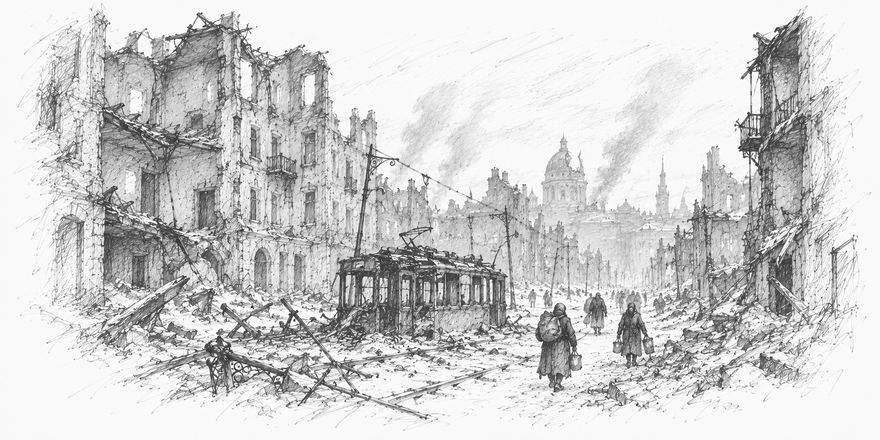
When the machinery of violence remains but the guarantee it once provided is gone, the state is left with a single form of existence: oppression. People stop cooperating with one another, the prosperity built up before soon dissipates, and so it goes until the next force gathers, makes new promises and begins a new round of the cycle. The orders of history have thus been like castles: built, filled with people, fallen, and rebuilt on the ruins.
The fourteenth-century Arab historian Ibn Khaldun described, in his Muqaddimah, a cycle that recurs again and again: a group of people bound tightly together by hard surroundings seizes power and founds a dynasty; their descendants enjoy prosperity in the cities, their solidarity loosens with luxury, and the rulers turn to mercenaries and heavy taxes to hold on to power; by the third or fourth generation the dynasty decays and is replaced by the next tightly bound group. He reckoned that a dynasty lasts about three generations, a hundred and twenty years or so.
More than seventeen hundred years before him, the Zuo Zhuan had already set down the same shape in eight characters: “how vigorous their rise, how sudden their fall”. China’s Twenty-Four Histories read almost like one long commentary on that line: a dynasty rises out of war, lightens labour and taxes, lets the people recover, and within a century the households multiply; then land is concentrated, the administration rots, taxes and levies grow heavier, and at last it falls amid vagrants and mutinies, and the next dynasty rebuilds on the ruins.
Order is built by a force that gathers, and is slowly hollowed out in prosperity by those who sit in the guarantor’s seat; and so the castle is built, filled with people, and falls, again and again.