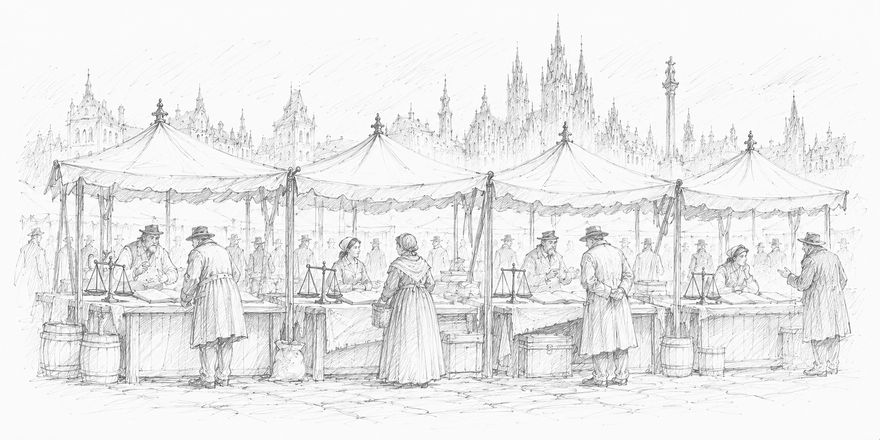
Why now?
This could not be done in the past, because enforcing rules required the hand of violence. For a contract to be enforced, someone must in the end take the money back from the party in breach, and only those who control the machinery of violence have that ability. A guarantee has therefore always been costly and scarce, something only states with large-scale organized violence could afford to supply.
Blockchains change this premise. A record written to the chain cannot be altered once written; a deployed contract executes its terms as written, and the room for reinterpretation, exemption and retroactive amendment closes at the moment of deployment; staked money leaves only along the few paths drawn in advance. People can enter into contracts freely, and the enforcement of those contracts is handed to mathematics.
A vending machine on a street corner could be called the earliest kind of smart contract: put in a coin and the goods drop; the terms of the deal are written into the machine, and the machine carries them out; the buyer deals with the machine alone, and the shop assistant’s part in the transaction disappears.
The difficulty is that a vending machine can sell only what has been loaded into it beforehand, and the money it guards is safe only inside its sheet-metal case; to extend the idea to contracts in general would take a machine that, once started, runs to the end exactly as built. On 3 January 2009 the first block of Bitcoin was mined, and Satoshi Nakamoto wrote into it the headline of that day’s Times: “Chancellor on brink of second bailout for banks”. In those months the guarantor was drawing on the whole of society’s future wealth to prop up the banks; what this block opened was a ledger final once written, beyond anyone’s power to tamper with.
In 2015 Ethereum went live, and anyone could deploy a contract to the chain, to be executed by the nodes of the whole network according to its code; from then on, that vending machine could hold any rule at all.
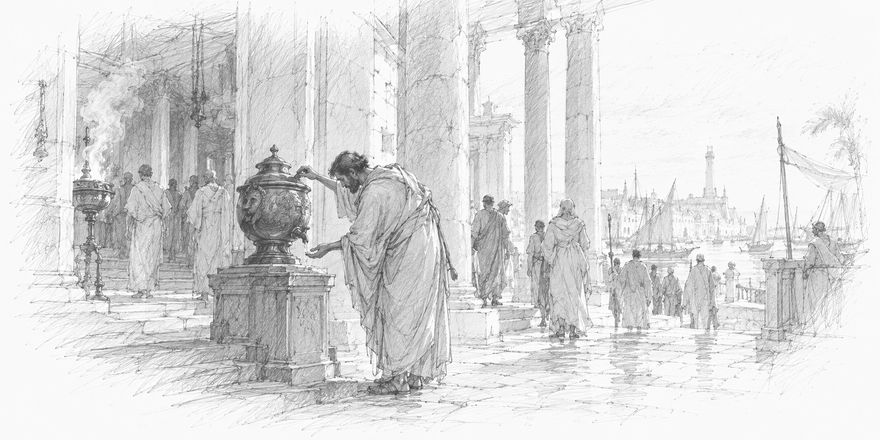
Guarantee and trust, that is, the order of right, thus become for the first time a market that anyone can enter. In it a person can choose rules and arbiters, or become an arbiter themselves and guarantee other people’s contracts on the strength of a deposit and a track record; functions that only the state could once afford can now be taken up, domain by domain, by individual people.
For choice to mean anything, things must be visible: the code of the contracts, each arbiter’s history and every record are open for anyone to read, the way out is always open, and order becomes a good that circulates and is priced in a free market.
In 1996 eBay introduced a feedback page: after every transaction, buyer and seller rated each other and wrote a line, visible to all. Strangers therefore dared to pay across half a country, and the good reviews a seller built up over years became his most valuable possession. The owner of that reputation, though, was the platform: once the account was closed, the reviews were wiped out, and moving to another platform meant starting again from nothing.
In this system, an arbiter’s track record is every ruling they have left on the chain: which case, when, and in whose favour, open for anyone to pull up and compare. The record is written on a public chain and follows the arbiter’s own address, going wherever they go; those choosing an arbiter look at this public record, and at the deposit staked there. What an arbiter has to sell is the credibility built up by all their past rulings.