Each person bears the burden of truth
A blockchain is a mathematical machine, and what happens in the real world lies outside its field of view. Whether goods were delivered, whether their quality matched what was agreed, it has no way of knowing; this is what is usually called the oracle problem.
“Code is law” was for a time held up as a creed in the blockchain community: however a contract executes, the result is thereby legitimate. Code, which could only ever serve as a tool, was raised here into a god and became the object of worship itself.
In the spring of 2016, a contract called The DAO raised about 12.7 million ether on Ethereum, some $150 million at the prices of the time and more than a tenth of all the ether in existence, promising that code would take the place of a fund’s managers. On 17 June, someone exploited a “re-entrancy” flaw in the contract’s withdrawal logic, making it pay out again and again before it recorded the balance, and drained about 3.6 million ether; an open letter said to come from the attacker then declared that he had merely taken the money by the rules the contract laid down, and that it was his lawful gain.
All that mathematical machine could see was one call after another, each in keeping with the code; whether those calls amounted to theft in people’s eyes lay outside its field of view. At that moment the creed ran into reality: if code is law, the money belongs to him. On 20 July, Ethereum returned the money to its original owners through a hard fork.
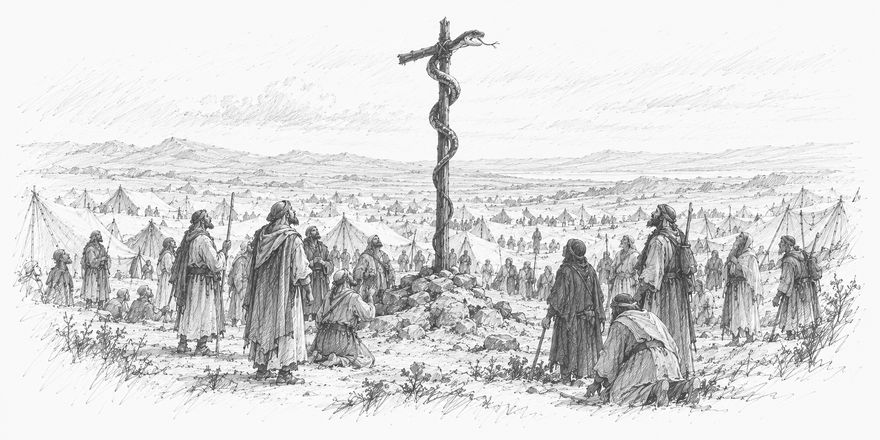
This history closely resembles the bronze serpent of the Hebrew Bible. When the Israelites were bitten by fiery serpents, Moses made a serpent of bronze and set it on a pole, and whoever was bitten looked at it and lived; centuries later the Israelites began to worship the object itself and burned incense to the bronze serpent. King Hezekiah broke it in pieces and called it “a mere piece of brass”.
Code is a tool of execution; what it can do is carry out, exactly as they stand, the things people agreed to beforehand. Once it is exalted as truth and justice itself, it loses the very power it had, and becomes meaningless.
The decentralized system of right handles it by sparing the chain from ever needing to know the truth: its role here is simply that of the enforcer that takes the place of the machinery of violence. All it needs is a ruling that both parties agreed in advance to be bound by, and what that ruling rests on is evidence the parties themselves recorded on the blockchain beforehand.
The burden of proof therefore falls on the party with a stake: whoever hopes to prove something later records it now, and so “no evidence was recorded” is in itself a conclusion that goes against that party. The arbiter thus has no need to go out into the world in search of the truth, and only has to examine the evidence both parties left behind. Even where the evidence on both sides falls short, the arbiter, as a person living in the real world, can send investigators to establish the facts, and a “refusal to be investigated” is in turn another conclusion that goes against the party who refuses.
The Digest of Roman law contains a maxim: the burden of proof lies on the one who asserts. For two thousand years courts have broadly kept to this rule, and added its other side: if the party holding evidence insists on withholding it, the court may find that the other side’s claims about that evidence are established.
The decentralized system of right moves both of these to the time before the transaction takes place. In this system, when a file is recorded with Zikaron, what is left on the chain is its fingerprint and the block time, proving that the content existed by that moment at the latest, while the original stays in the recorder’s own hands.
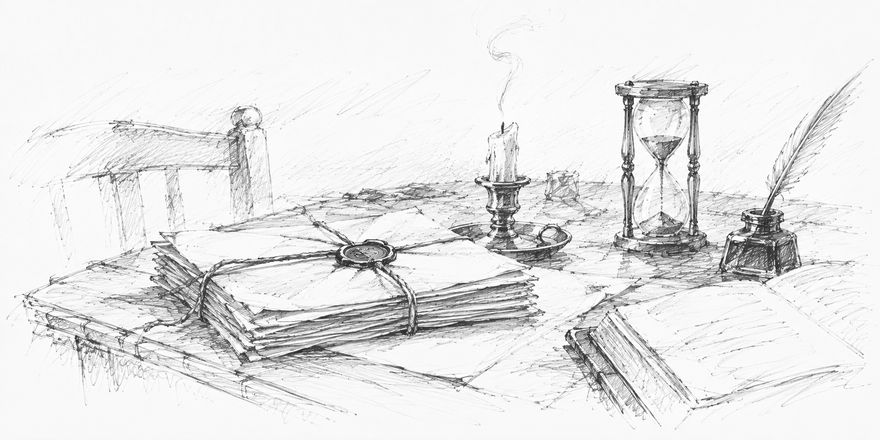
At delivery, the seller packs photos, receipts and messages into a record kit; if a dispute arises, they present it to the arbiter, who checks each original against its fingerprint on the chain. Whoever hopes to prove something later records it now, and all the arbiter has to do is check what is laid before them.
The ruling belongs to the person both parties chose in advance, following a set of rules both parties agreed to in advance. What this person faces is the two bodies of evidence laid before them, and what they judge is which of the two holds up. People are willing to entrust the ruling to them because of a plain fact: one unfair ruling lowers their chances of being chosen the next time. The trust that would otherwise have to be placed in an oracle is carried instead by the division of roles among people.
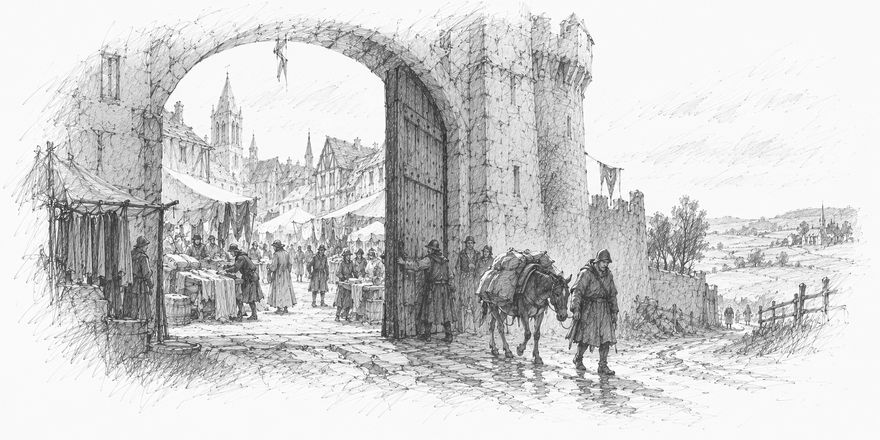
In the twelfth and thirteenth centuries, the fairs of Champagne in France were held in rotation each year, and Flemish cloth merchants, Italian bankers and traders from everywhere came there to deal. The fairs had courts of their own that settled disputes swiftly by the customs merchants kept among themselves, a body of custom later ages called the law merchant. Behind their judgments stood a plain fact: a merchant who defied a ruling would be driven from the fairs, sometimes together with the merchants of his city, and so lose every counterparty he had there.
Today’s international commercial arbitration carries on the same arrangement: each side chooses arbitrators, and the New York Convention of 1958 lets awards be enforced in more than a hundred and seventy contracting states; an arbitral institution’s reputation decides how many will bring their cases to it next time. Arbiters are willing to be fair because their next piece of business depends on this ruling.